Why the 6×4 Tractor Head Is the Go-To Choice for Bulk Fuel Tanker Haulage
The Nature of the Load — Why Fuel Is Different
Before considering the tractor, it is worth understanding what makes a tanker load distinctive. Three characteristics separate it from dry freight:
High density. Fuel is heavy for its volume. A tanker trailer reaches its legal gross weight at a relatively small fill volume, meaning the tractor spends most of its working life coupled to a trailer at or near maximum weight. There is little margin between "partly loaded" and "at the limit."
Moving load. Liquid moves. When a partially filled tanker brakes, the fuel surges forward; when it corners, the fuel shifts sideways; when it accelerates, the fuel lags behind. Anti-wave baffles inside the tank reduce this effect, but they cannot eliminate it. The tractor must be able to handle a load whose centre of gravity shifts during every manoeuvre.
High centre of gravity. A loaded tanker carries its weight high and wide. Compared to a container chassis or a flatbed carrying dense goods low to the frame, a tanker has a higher centre of gravity — which makes lateral stability, braking balance, and even weight distribution across the axles more critical.
These three characteristics — constant high weight, moving load, and high centre of gravity — explain nearly every advantage the 6×4 layout offers in tanker haulage.
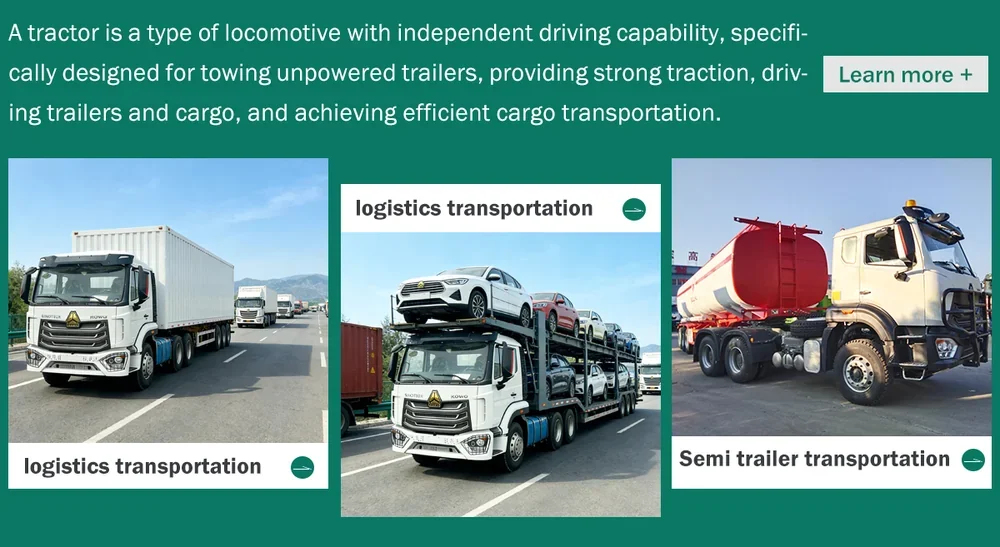
Advantage 1: Traction Under Constant Heavy Load
The 6×4 layout provides four driven wheels across tandem rear axles. In fuel haulage, this matters in two distinct ways.
First, tanker operations frequently involve unpaved or poorly surfaced access — depot yards, terminal areas, and the final approach to construction sites, power generation facilities, or remote mining camps that need bulk diesel delivered. On soft, gravel, or rain-affected ground, a four-wheel-drive tractor maintains traction where a 4×2 would spin its single drive axle under load.
Second, even on paved roads, the constant near-maximum weight means the drive axles are working hard from the moment the tractor pulls away. Spreading drive torque across two axles reduces the load on each differential, half-shaft, and wheel bearing — extending component life in a duty cycle where the truck is never running light.
Advantage 2: Load Distribution
A 6×4 spreads the combination's weight across three axles on the tractor rather than two. For tanker work, where the gross combination weight is consistently high, this distribution is what keeps individual axle loads within legal limits. In markets that enforce axle-weight regulations on fuel transport corridors — which is most of them, given the hazardous-goods nature of the cargo — staying compliant depends on having enough axles to spread the load. A 6×4 provides that margin; a 4×2 often does not.
Advantage 3: Braking Performance
This is arguably the most important advantage in fuel haulage. Stopping a loaded tanker requires dissipating a very large amount of kinetic energy, and doing it without the load shifting forward and unsettling the vehicle. More axles mean more brake contact area and more braking force distributed across the combination. The 6×4's tandem drive axles contribute significantly more retardation than a single rear axle could provide.
All modern HOWO and Shacman tractor heads are fitted with dual-circuit compressed air brakes and ABS as standard. On a tanker combination, these systems are not optional features — they are baseline safety requirements. The 6×4 layout complements them by giving the braking system enough axles to work with.
Advantage 4: Lateral Stability
A tanker's high centre of gravity makes it more susceptible to roll than a low-slung dry-freight combination. The 6×4's wider axle footprint — and specifically the tandem rear axle arrangement — provides a more stable platform against lateral forces during cornering and lane changes. In tanker operations, where the load can shift sideways mid-corner, this stability margin is a safety asset, not a performance nicety.
Tanker-Specific Considerations Beyond the Axle Count
The 6×4 layout is necessary for safe tanker haulage, but it is not sufficient on its own. Operators specifying a tractor for fuel tanker duty should also consider:
Smooth, predictable torque delivery. Tanker haulage rewards engines that deliver torque progressively rather than in surges. Abrupt power application unsettles the moving load and can cause the trailer to sway. Engines matched to multi-speed gearboxes — such as the HW19710 (10 forward speeds) or HW19712 (12 forward speeds) fitted to HOWO tractor heads, or the FAST 12-speed units on Shacman models — allow the driver to apply power smoothly and keep the combination settled.
Consistent braking under load. Confirm the tractor's braking specification and that the trailer's brake system is compatible. Tanker trailers often use their own brake systems, and balanced braking between tractor and trailer is essential when the load is heavy and moving.
Appropriate fifth wheel. Tanker trailers commonly use JOST heavy-duty fifth wheels in 50# (2-inch) or 90# (3.5-inch) pin sizes. Confirm the tractor's fifth wheel matches your trailer fleet to avoid an incompatible coupling.
Reliable cooling in hot climates. Fuel haulage often runs in high ambient temperatures, and tanker routes frequently include long gradients. A cooling package sized for the climate prevents the overheating that becomes a maintenance cost and, in extreme cases, a safety concern near flammable cargo.
When 6×4 Is Not the Only Option
An honest assessment should note the limits of the recommendation. The 6×4 is the standard for mainstream fuel tanker haulage, but alternatives exist for specific cases:
4×2 for light, short-distance, paved-only distribution. Where a tanker runs at lower gross weights on good roads — small-volume deliveries to urban filling stations, for example — a 4×2 may be adequate and cheaper to buy and run. The trade-off is reduced traction, lower legal payload, and less braking capacity.
8×4 for the heaviest single-vehicle configurations. Where the operation demands maximum legal payload and the site conditions are the most challenging, an 8×4 provides additional load-spreading and traction. The trade-off is higher purchase cost, more weight, and longer vehicle length.
For the broad middle ground of fuel haulage — depot-to-station delivery, bulk delivery to remote sites, cross-border fuel distribution — the 6×4 remains the configuration that best balances capability, legality, and cost.
What to Confirm Before Ordering a Tractor for Tanker Duty
Gross combination weight rating and maximum permitted trailer weight in your market
Axle-weight regulations for fuel transport corridors in your destination country
Rear axle ratio matched to your route profile — gradients versus highway cruise
Fifth wheel pin size — 50# (2") or 90# (3.5") — matched to your tanker trailers
Brake system specification and compatibility with trailer brake systems
Engine power rating matched to your typical load and terrain (371hp / 400hp / 430hp range on HOWO; 340–430hp on Shacman F3000)
Cooling system capacity for your climate
Left-hand-drive or right-hand-drive configuration
Warranty scope, spare parts support, and delivery terms (FOB / CFR / CIF)
Conclusion
The 6×4 layout has become the go-to choice for bulk fuel tanker haulage for reasons that follow directly from the nature of the load. Constant high weight demands traction and adequate axle count. A moving load and high centre of gravity demand braking capacity and lateral stability. The 6×4's tandem drive axles deliver all four — which is why virtually every purpose-specified fuel haulage tractor on the road is a 6×4. For operators specifying a tractor head for tanker duty, the axle layout is the first decision, and the default answer is well established. From there, match the engine rating, gearbox, fifth wheel, and cooling specification to your routes, and the combination will handle the weight safely for years.
For specifications, configuration options, and delivered pricing on 6×4 tractor heads suitable for fuel tanker haulage, contact the Shandong Chengda Truck Trailer team.