1. Horsepower — It's Not Just About the Number
Horsepower (hp or PS) measures an engine's power output. In the Chinese truck market, common horsepower ratings for heavy-duty trucks range from 280hp to over 500hp. Simply put, more horsepower means a stronger engine — but "bigger is always better" is not the right logic here.
Horsepower Tiers and Their Real-World Uses
280–340hp: Suitable for short-to-medium-haul logistics, standard payloads, and primarily paved roads. Better fuel economy and lower purchase cost. Typical models include mid-range Foton Auman and HOWO tractor configurations.
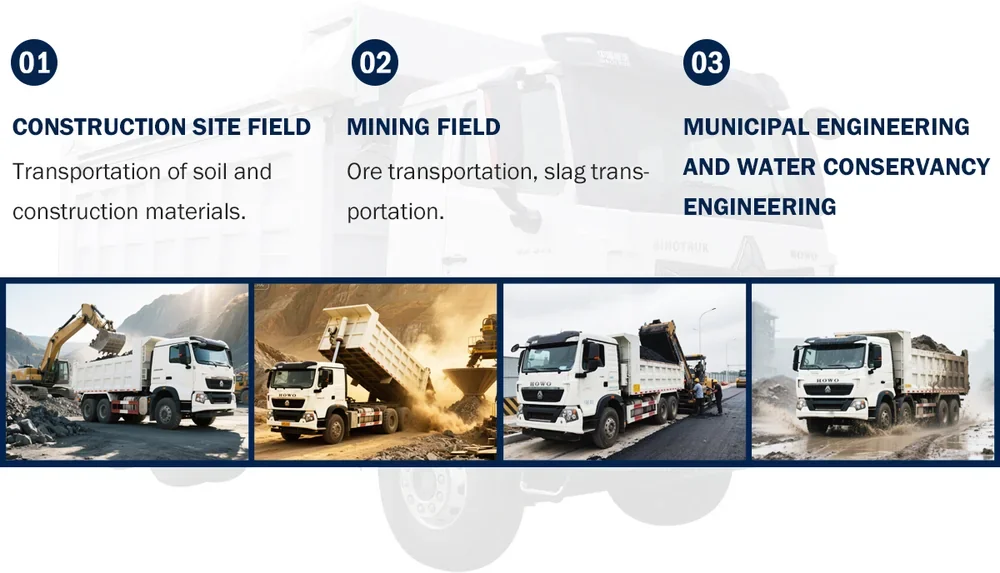
350–400hp: The most common horsepower range for Chinese heavy trucks. HOWO 371hp and 400hp dump trucks and tractor heads fall into this category. Suitable for construction site transport, mining operations, and medium-to-long-distance logistics. This range strikes a good balance between power and fuel consumption. For most construction and engineering projects in Africa and Latin America, this horsepower level is usually sufficient.
420–500hp+: Designed for heavy-load long-distance transport, mine-site steep-grade hauling, and oversize cargo transport. HOWO 430hp tractor heads and certain high-power Foton Auman EST variants sit in this tier. Ample power, but higher fuel consumption. If your daily workload doesn't require this much output, the extra horsepower simply wastes fuel.
The Key Principle
Choose horsepower based on your most common operating conditions, not the most extreme scenario. If 90% of your truck's time is spent on flat highways with standard loads, you don't need a 450hp engine for the occasional steep hill. Conversely, if your trucks consistently work on mine-site grades or run at maximum payload, under-speccing the horsepower forces the engine to operate under sustained high load, which shortens engine life and may actually increase fuel consumption.
2. Axle Configuration — Determines Payload Capacity and Terrain Capability
Axle configuration is expressed as "number of drive wheels × total number of wheel ends." This is the most critical — and most easily confused — parameter on a Chinese truck spec sheet. The number of wheel ends determines both load capacity and off-road traction.
Common Axle Configurations
| Configuration | Meaning | Typical Application | Common Models |
|---|---|---|---|
| 4×2 | 4 wheel ends, 2 driven (single rear drive axle) | Light dump, urban delivery, short-haul logistics | HOWO 4×2 mini dump, Foton light trucks |
| 6×4 | 6 wheel ends, 4 driven (tandem rear drive axles) | Medium-to-heavy dump, standard tractor, site transport | HOWO 6×4 dump, Shacman F3000 6×4, Foton Auman 6×4 |
| 8×4 | 8 wheel ends, 4 driven (twin front steer axles + tandem rear drives) | Heavy dump, mining transport, maximum payload operations | HOWO 8×4 dump, HOWO TX 8×4 |
| 6×2 | 6 wheel ends, 2 driven (one front axle may be a lift/tag axle) | Medium-to-long-haul tractor, express freight | Select Foton tractor models |
How to Choose an Axle Configuration
Consider road conditions: If your routes are primarily paved highways, 4×2 or 6×2 is adequate. If the work involves construction sites, mines, or unpaved roads, 6×4 is the minimum, and 8×4 is the safer choice. More driven wheels mean better traction on soft or loose surfaces.
Consider payload: Axle configuration directly determines the legally permitted gross vehicle weight. Using Chinese standards as a reference (always check destination country regulations): 4×2 typically corresponds to a gross weight of 16–18 tons, 6×4 to 25–31 tons, and 8×4 to 31–40+ tons. If your daily haul tonnage is high, choosing too few axles will lead to overloading and premature vehicle damage.
Check local regulations: Every country sets its own axle load limits. Before purchasing, confirm the maximum permitted axle load and gross vehicle weight in your destination country, then work backward to determine the required axle configuration. An 8×4 dump truck legally rated for 40 tons in China may only be permitted to carry 31 tons in your country.
3. Payload Ratings — The Difference Between Rated and Real-World Capacity
Payload rating is another parameter that is easily misunderstood. Chinese trucks typically carry two related capacity figures:
Rated Payload: The manufacturer's design payload capacity, printed on the vehicle data plate and certificate of conformity. This is the design limit for safe operation under standard road conditions.
Real-World Capacity: In practice, many operators exceed the rated payload. Chinese truck chassis and frames are generally designed with generous safety margins, but long-term overloading significantly accelerates wear on tires, suspension, braking systems, and the frame itself.
Chassis Strength Is the Foundation
Payload capacity depends not only on axle configuration but critically on chassis structural design. A high-tensile steel chassis can withstand greater bending and torsional stress without deforming compared to standard steel. Heavy-duty dump truck models from brands like HOWO and Shacman typically use double-layer or reinforced frame rails — this is a key reason they are suited to mining and heavy-load conditions.
When selecting a payload rating, a practical rule is to match vehicle rated capacity to your "daily actual payload plus a 20% safety margin," rather than buying a truck that is just barely adequate at its maximum rated figure.
4. Putting It All Together — Two Real-World Scenarios
Scenario One: Urban Construction Debris Hauling
Routes primarily on paved city roads, short trips, frequent stops and starts, moderate traction requirements but decent payload needed. Recommended configuration: HOWO 6×4 dump truck, 340–371hp. The 6×4 layout provides sufficient drive-wheel traction, and 340–371hp delivers adequate power for short-haul duty with manageable fuel consumption.
Scenario Two: Mine-Site Heavy Haul with Steep Grades
Routes include long uphill sections, unpaved or heavily rutted surfaces, medium trip distances, high demands on payload and traction. Recommended configuration: HOWO 8×4 dump truck, 400–430hp. The 8×4 layout provides a higher legal gross vehicle weight limit and better stability. 400hp and above ensures the engine does not struggle when climbing under full load.
Summary
Chinese truck specifications follow a logical system. The key is to evaluate three parameters together: horsepower determines how fast the truck can move and whether it can climb; axle configuration determines how much it can carry and whether it can handle rough terrain; payload rating determines how much structural stress the chassis can absorb over time. Mismatch these three, and the result ranges from poor operating efficiency to premature vehicle write-off.
Operating conditions across African and Latin American markets are diverse — no single specification fits every project. Matching the right horsepower, axle configuration, and payload rating to your specific operation is a far smarter approach than chasing the highest spec or the lowest price.
For more information on specifications, configuration options, and port-delivered pricing for HOWO, Shacman, and Foton dump trucks and tractor heads, contact the Shandong Chengda team.